
COLLAB2021 – HQ – Stylized Fantasy Environment
Forum Archive › COLLAB2021 – HQ – Stylized Fantasy Environment
- This topic has 510 replies, 67 voices, and was last updated 4 years, 6 months ago by
Kent Trammell.
-
AuthorPosts
-
April 12, 2021 at 12:54 pm #63543
@adrian2301 Nice idea about the flow of the water, there should be a more poweful flow to turn the wheel. @lexicolopolis It’s indeed custom to build the foundation all the way down into the water to prevent erosion. I’m a structural engineering by day 😉 so that’s how I would design it :).
April 12, 2021 at 1:29 pm #63544Sidetracking here: for bearings that are under water, people tend (or tended, I am not sure if they still do this) to use pockwood, which is a hardwood that has the property, that is becomes ‘greasy’ when wet. It is self-lubricating!
‘Interesting’ fact is that there is a tool, used by church organ tuners, that is traditionally also made of pockwood…
April 12, 2021 at 2:09 pm #63545@spikeyxxx I’m not familiar with pockwood. Do they use it as a foundation or just for cladding?
April 12, 2021 at 2:09 pm #63546Hey, how do I create a WIP thread here on CG cookie?
April 12, 2021 at 2:18 pm #63547Hi @robcampbell26 – Check out this part of last week’s stream.
April 12, 2021 at 2:21 pm #63548@daphne2 Indeed you’re on my registration list! Have Week 1’s task is so simple, I don’t think you will have any issue catching up in week 2.
I just shared out the asset spreadsheet and google drive folder. Please commend on the asset you’d like to build, get synced up to the folder, create a WIP thread, tag me in your week 1 homework post and I’ll grade it 👍
April 12, 2021 at 2:26 pm #63549@lucky for underwater ball bearings for instance, like in ship’s propeller shafts or in wooden sluices. As far as I know, not so much for watermills…
April 13, 2021 at 11:02 pm #63550Don’t really know where to post this, but the Multiresolution Modifier has some strange and confusing naming convention:
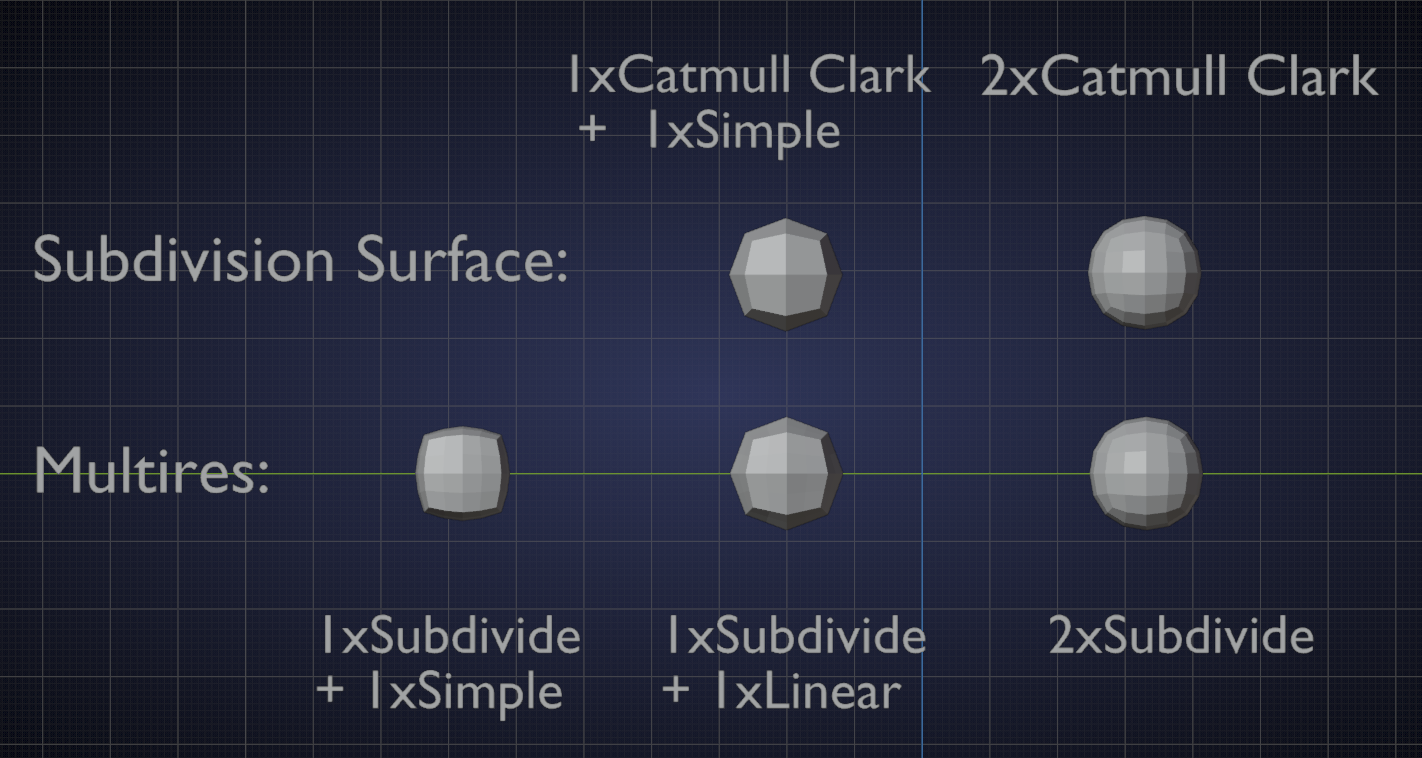
The difference between Simple and Linear only becomes clear on a deformed (by Sculpting for instance, but also like in the example above) Mesh, whereby Linear is like Simple in the Subdivisio Surface Modifier and Simple is something new, smoothing, but smoothing the original Mesh less…..or something like that.
April 14, 2021 at 8:36 am #63551Thanks for digging into this @spikeyxxx! Now that I’m seeing your example, I seem to remember the simple subdiv example used for (kind of) retaining suggested hard edges in a lo-poly base. Which is why it’s more cubish than spherical. So I guess it’s attempting to preserve suggested hard edges that don’t have holding edges like I added yesterday…
Interesting option but still seems a bit half-baked to me. Holding edges I can trust.
April 14, 2021 at 8:49 am #63552Great question @wardred. I think only the FG trees should feature the small branches you’ve presented in the screenshot. MG trees can have the thicker branches but thinner branches should be removed (i.e. hidden by the leaves). BG tree clusters will only be the trunks with all branches non existent ( fully hidden by their leaves)
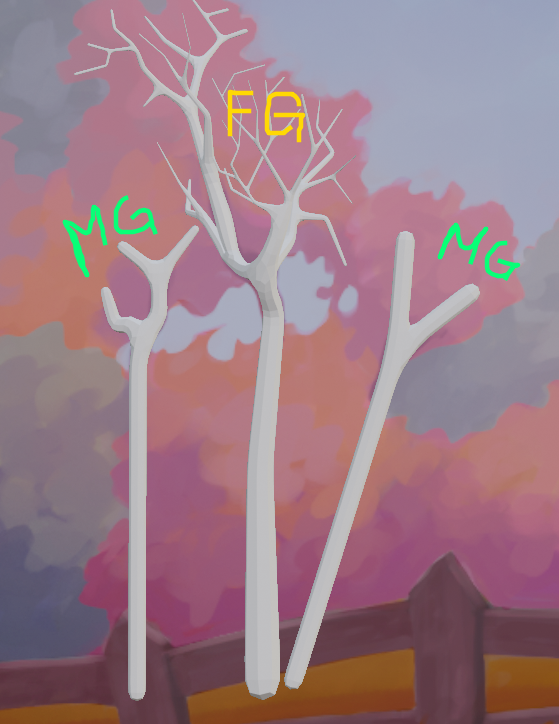
I’m planning to spend some time this week researching foliage methods. Look for a post from me about this and clarifying things like level of detail in the nature team post.
April 14, 2021 at 6:14 pm #63553I originally posted this to my team thread, but it might be better to put here:
I have a question about data linking, optimization, and performance.
I understand the benefits of using data linked objects for the sake of mapping numerous UVs to the same map space, and thus cutting down overall texture data. Clearly with that comes reduced time painting, and modeling.
But is data linking reducing the data load based on the vertices themselves? I imagine that you’re essentially instancing the object, which I’ve always believed had huge performance advantages, but I don’t know why I think that.
From a rendering standpoint, I could see that you’d probably be getting better performance on memory allocation by having smaller data chunks with the linked object data, but the instanced copies in my example below have faces that aren’t being culled on the interior, so the payoff would probably be less. Not sure if I’m assessing this correctly.
If data linking does increase poly-related performance, does this translate to other environments? For example, can you export to Unity in a way that the data-linked geometry is functioning as multiple copies of the same base object? Or would you have to use a different method to have this translate properly?
EXAMPLE:
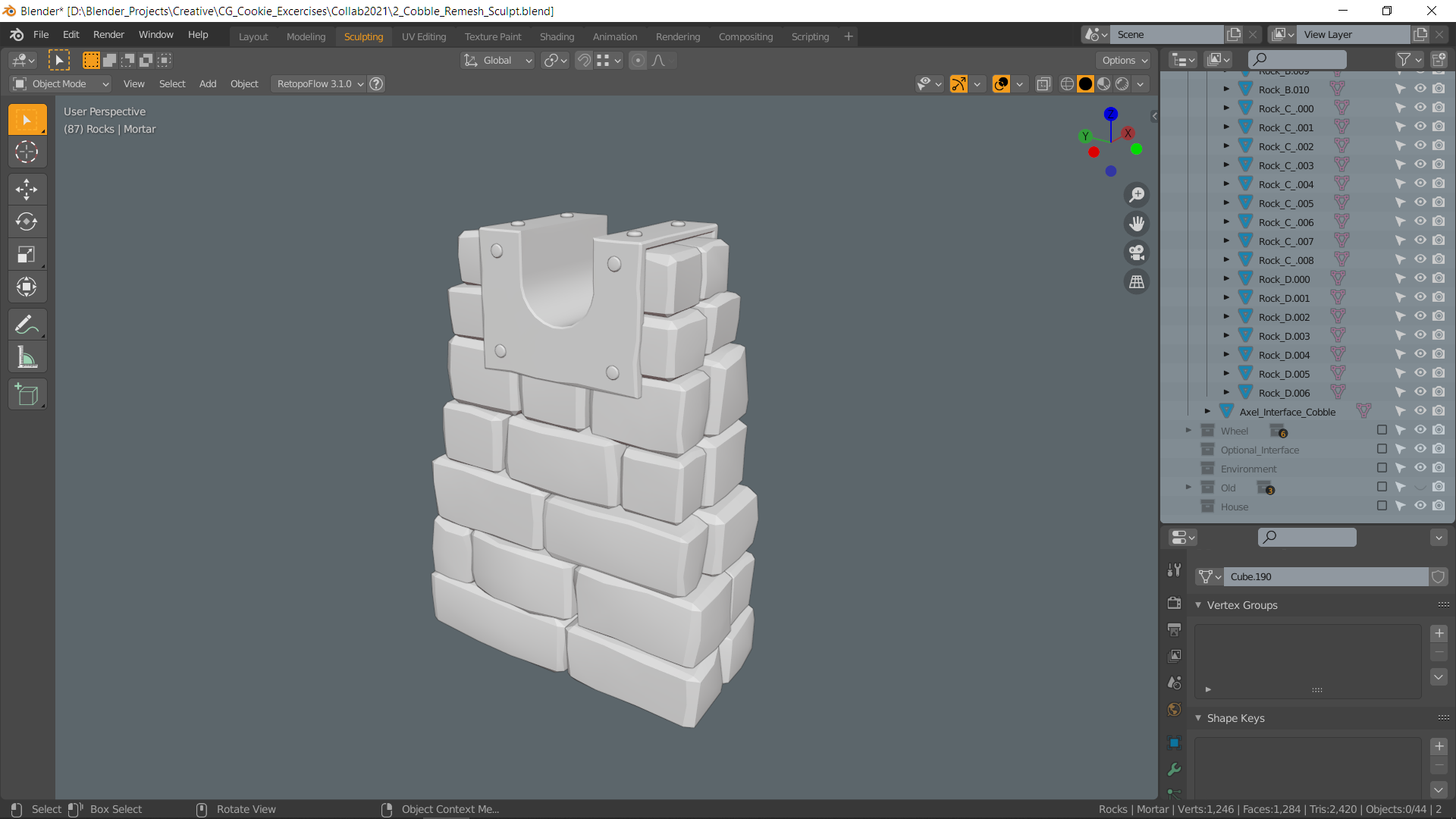
Having these stones setup as 4 stones that have been duplicated and data linked gives me 278 verts. As single users they hop up to 2k.
Alternately by making them single users, booling out their interiors, and then optimizing their geometry the best I could, got me down to 1,483, without data linking.
Retopo looked like it could get MAYBE get me closer to 1000. I started it to see how much labor was going to be involved with what kind of reward, and about 40% through I was already at 500.
So, what approach would be a) most optimal for performance as it relates to this project? and b) most optimal as it relates to exporting assets to game engines or other environments?
April 14, 2021 at 10:34 pm #63554@theluthier Just wanted to ask if you have and if you have sorry I missed it but have you posted the footbridge yet somewhere?
Thanks.
April 15, 2021 at 4:53 am #63555@theluthier Any word on if @splat21 is still doing a blog of Collab2021? Thank you.
April 15, 2021 at 5:28 am #63556April 15, 2021 at 9:17 am #63557 -
AuthorPosts


- The topic ‘COLLAB2021 – HQ – Stylized Fantasy Environment’ is closed to new replies.