
Seven is the number of perfection
Forum Archive › Seven is the number of perfection
- This topic has 27 replies, 4 voices, and was last updated 5 years, 3 months ago by
spikeyxxx.
-
AuthorPosts
-
June 1, 2021 at 11:19 am #60312
@spikeyxxx the fractions represent an infinite repeating pattern going down to infinitely smaller…
and you point out, that is governed by the odd or even condition of the denominator…
fascinating that the 1/7 fraction repeats on a 6 digit pattern… is the denominator -1 a constant pattern?
(you put the space in the 1/29 pattern to indicate the number of digits before repeat being 28?)
is there an infinite repeating pattern that goes larger?
(something tickles about the golden ratio and the spiral it produces… and moving it into 3D space rather than the 2D pattern we use it to represent…)
(it’s an idea that has not yet reached completeness in my mind…)
@duerer I’m of the mindset that the mathematical patterns we see are intertwined with the theological things you spoke of…
June 1, 2021 at 11:24 am #60313@me1958424 did you mean, that you can get a fraction a/b as small as you want, while it still would be repeating a sequence of digits?
In that case, you can, it is even extremely simple; just write any natural number and repeat its digits infinitely…
But, that wouldn’t have any of the nice properties, that fractions have.
For instance: 1/7 = 0.142857…, like we already established, but multiplying this by a natural number, cycles through those digits!
2/7 = 0.285714… 5/7 = 0.714285… and so on.
You would not have something like this, when you’d divide one of those infinitely large numbers.
The thing is, I think, that those large, repeating numbers are constructed, while the fractions repeat naturally….I hope that makes some sense to you 🙂
June 1, 2021 at 12:25 pm #60314you point out, that is governed by the odd or even condition of the denominator…
not really the odd/even condition, but whether there is a common factor between 10 and the divisor (when the fraction itself is in its ‘simplest’ form…)
fascinating that the 1/7 fraction repeats on a 6 digit pattern… is the denominator -1 a constant pattern?
It is, when the divisor is a prime number!
It could have been a 1 digit pattern, a 2 digit pattern, a 3 digit pattern, or a 6 digit pattern, because those are the divisors of 6.
Let me try to clarify this, without going into abstract algebra and group theory too much.
The following applies to all primes that are not 2 or 5 (because those are divisors of 10…), but we will concentrate on 7, for simplicity.
Now, 1/ 7 is something and 2/7 is something else and so on…but then something amazing happens: 7/7 = 1.00000000…
8/7 = 1 + 1/7
So, considering only what happens behind the decimal point, in the case of dividing by 7, the only interesting cases are:
1/7, 2/7, 3/7, 4/,7, 5/7, 6/7. And if you care to count them, that are 7-1 = 6 cases!
Let me now remind you of doing long division (I hope that is what you call them):
It might look something like:
7/1.00000…\ 0.142
7
30
28
20
etcetera…
If you know anything about modulo, you would recognize that 20 is congruent to -1 modulo 7 (3*7 – 1) and that means that 20² is congruent to 1 modulo 7
While writing this, I realize, that all this is going to be more confusing than enlightening, but let’s try a bit more…
Suppose, that 100000/7 would yield a rest of 1 (there would exist a natural number n, so that 100000 = n*7 + 1), then in the above long division, there would be a 1 at the fifth decimal, meaning the digits would start to repeat themselves…
but, they obviously repeat themselves after 6 digits (
‘So, considering only what happens behind the decimal point, in the case of dividing by 7, the only interesting cases are:
1/7, 2/7, 3/7, 4/,7, 5/7, 6/7. And if you care to count them, that are 7-1 = 6 cases!’
), so if they repeat after 5 and 6 digits, they must repeat after 1 digit. Try all cases and you will hopefully get a feel for why the
number of digits, when 1/p, with p being a prime, not equal to 2 or 5, repeats after a number of digits, that is a divisor of p-1.
Don’t worry if you don’t, I had a lot more mathematical knowledge when my math professor first showed this to me and I thought he was doing magic 😉
June 1, 2021 at 2:53 pm #60315“The thing is, I think, that those large, repeating numbers are ‘constructed’, while the fractions repeat ‘naturally.’…”
when you say constructed and occur naturally is a large help…
the construct is “man made”?
I follow the basic arc of the modulo part but as you noted I probably do not know enough math to take it in in it’s entirety…
understood about it appears to be magic 😀
June 1, 2021 at 3:37 pm #60316the construct is “man made”?
Exactly!
(And modulo math is extremely powerful and allows one to do calculations that go way beyond what you can do with a calculator or computer per se…but some of the real power comes from combining ‘math tricks’ with computer power….)
June 1, 2021 at 3:50 pm #60317…and here is another great channel, if you want to get an idea of modern number theory/ abstract algebra:
All the math here is explained clearly and accurately (and it will probably make your head spin, but don’t worry about that 😉 eventually things will start to make sense and you might become a magician yourself)
June 1, 2021 at 3:51 pm #60318but some of the real power comes from combining ‘math tricks’ with computer power
Stunningly beautiful:
 June 1, 2021 at 4:44 pm #60319
@duerer the underlying math of this picture is both simple and extremely complex at the same time 😉
June 1, 2021 at 6:02 pm #60320I love fractals!
June 2, 2021 at 2:38 pm #60321@spikeyxxx does this illustrate the previous idea in a more significant way?
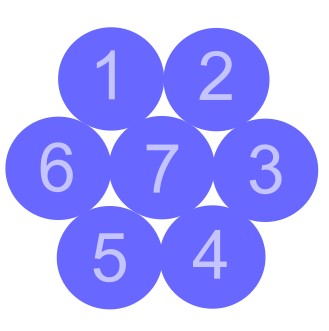 June 2, 2021 at 3:37 pm #60322
@me1958424 not to me, I still see a spiral and not a circle with a center. Remember those numbered dots that you had to connect in order, to make a drawing of a palm tree, or…I must have made too many of them 😉
Actually liked the one with the hexagons better.
You asked about those infinite patterns that grow larger, now I thought of something; there exists something a p-adic numbers (where p is a prime).
you could also use 10-adic numbers, although they are not commonly used.
Where rational numbers can go infinitely to the right (after the decimal point), 10-adic (or decadic) numbers can go infinitely to the left.
Look at this:
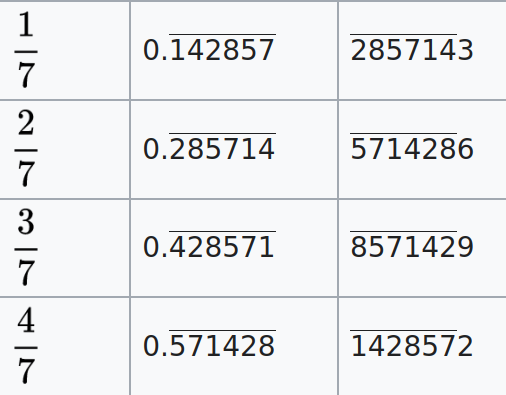 the lines above the digits mean that that part repeats. The right ones are the decadic numbers and they also ‘rotate’ when you multiply 1/7 by an integer that is not a multiple of 7. And they even consist of the same digits as the decimal ones.
But for something to be larger, there needs to be some kind of ordering and that is missing in this system, so not exactly what you were looking for, I guess.
But when talking about circles and their center, I had to think about this, because in a p-adic circle, every point inside that circle is its center (mind-blowing, right?).
June 2, 2021 at 5:22 pm #60323@spikeyxxx yeah the obvious question becomes how can anything but the center be the center? (no explanation is needed) 😀
June 3, 2021 at 12:16 am #60324@me1958424 someone once said that it is a bit like God is in the center and everywhere at the same time 😉
-
AuthorPosts


- The topic ‘Seven is the number of perfection’ is closed to new replies.