
Reply To: Polybook – Jake
Forum Archive › Polybook – Jake › Reply To: Polybook – Jake

The capability of modeling down to millimeters of precision definitely exists in Blender. The fields that display figures like sizes and locations are truncated and rounded normally, but if you click the field (as if you’re going to edit it) you will see that Blender will accept and be faithful to as many significant digits as you care to throw at it. I dunno, maybe there’s a limit, but if there is, it’s a greater level of precision than you’d ever have a need for. Just for one example – I won’t explain the context (it’d take a while); but one time I modeled a several-kilometers-long object, gave it a very specific curve with a modifier, and verified the verts in the middle of the curve being exactly where the math says they ought to be to SUB-millimeter precision. So yes, the software can do it!
The problem you’re mostly going to have is getting your hands on the data. Where you can FIND the data, you can model as precisely as you want to. But for most things sadly it’s not not available, at least not publicly or easily available; and that is unfortunately the reason why most of the modeling you’ll see in Blender is by eye. If you can FIND a list of CAD-precision measurements for a whole thing, by all means exploit it! But chances are more likely that you’ll find a few very precise figures for some parts of it, and you’ll have to do the rest from the best photos and drawings you can find. So the key is always collecting the best reference you can, and as much of it as you need.
This vehicle I’m making is a little bit more of a “passion project”, I think you could say, than anything I’ve made before. So I really went all out in terms of preparation. For instance, here’s the numbers from my reference folder just for this one single project:
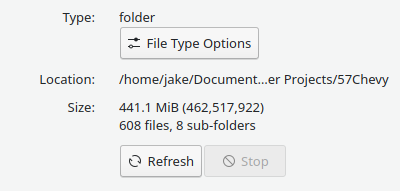
Those are ALL and NOTHING BUT reference images – photos, drawings, and diagrams – for this vehicle that I’ve found online. The amount of reference I’ve gathered for this project beats the next-highest one of mine by around an order of magnitude, ha. It’s kind of ridiculous, admittedly, and the only reason it’s like that is because I knew I was going to be modeling like the complete chassis of this car, meaning that I have to have reference for a lot of components that a typical car-modeling project would just not need.
So it wouldn’t be honest to say that this is my “normal” process. But yeah, I really went in-depth. I found the car’s actual factory assembly instructions, which contained a lot of useful information and measurements. I found photoscans of some of the original promotional material that, interestingly, contained a lot of very precise orthographic cross-sections. And of course, lots and lots (and lots) of photos, from targeted searches. In some cases I went as far as looking up the technical names and even part numbers for some components to get the material I needed, which required a little bit of its own researching. And don’t be afraid to create your own “photos” by skimming YouTube videos to find a couple that happen to very clearly show that one part or angle you just can’t find an actual photo of anywhere, and take screenshots! I didn’t do it all at once, but I think if you added it up I spent a solid week on JUST gathering reference materials. And I’m not even done really; if I’m in the middle of making a certain part and what reference I already have doesn’t cut it, it’s back to the internet to find some more.
I used essentially the same processes to find reference material to share with the group for the DOG backhoe collab project, if you’ve looked into that.