Reply To: Michael’s Polybook and Progress — (Am I doing this right?)
Forum Archive › Michael’s Polybook and Progress — (Am I doing this right?) › Reply To: Michael’s Polybook and Progress — (Am I doing this right?)

TL;DR: I built a staircase for the house, designed the grill in Inkscape, and modeled draped cloth in Marvelous Designer.
Lately I’ve been working on the main staircase for the house, which involved reading lots of books – circa 1850-1900 – on stair construction. There’s so much mathematics and geometry involved; the books make for some dry reading and I’ve always been terrible at math. Still, I’m striving for accuracy for the time period.
Here’s something I learned: Always plan out your staircase rise/run and dimensions before you finalise your floorplan! The original floorplan drawing (from 1884) that I based this house loosely upon, showed a straight flight of stairs in the front hall, but it was impossible to actually fit it.
So, I altered my floorplan slightly, and designed some double winder stairs which fit perfectly.
Here’s the staircase structure, parented to an empty which makes it easy to keep track of all the parts.
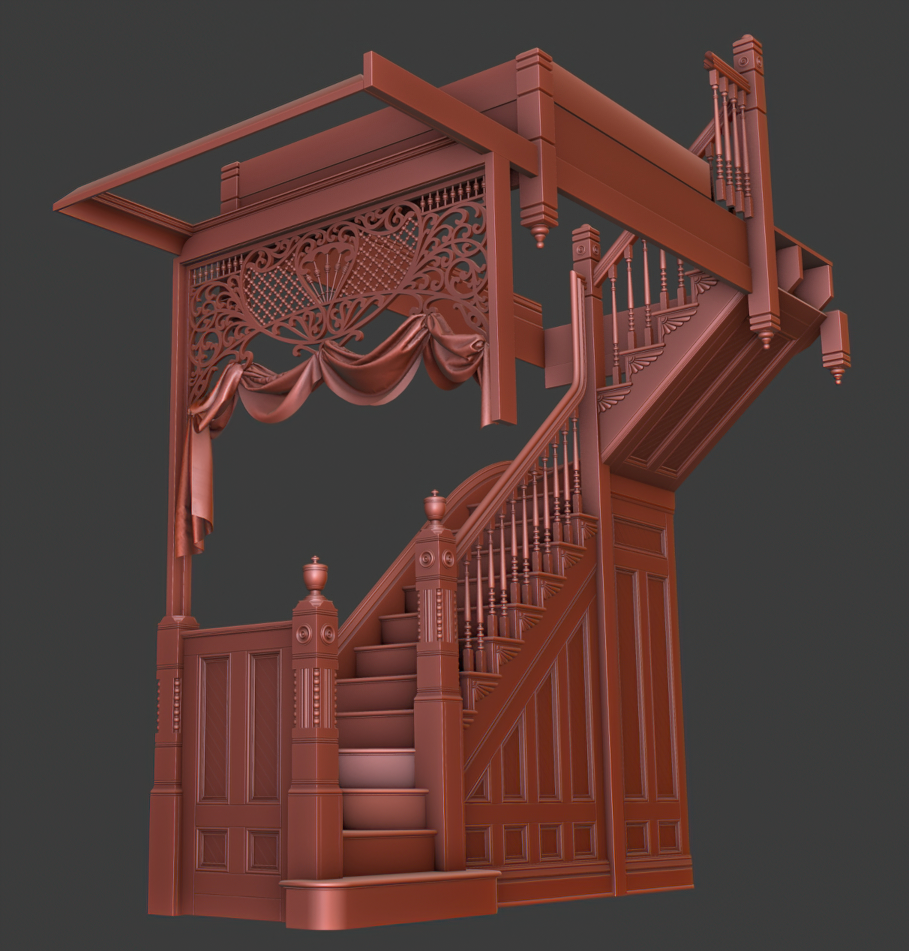
I usually slide it -200m along the X axis to work on it, and the slide it back 200m to check the fit. When I work on sections of it, I just select those parts and isolate the view. It’s a huge project with lots of parts, but I’ve managed to organise my collections (and with nested collections), so it’s been surprisingly easy to work on different parts of the house without getting overwhelmed.
Here, it’s slid into place, viewed from the top of the stairs:
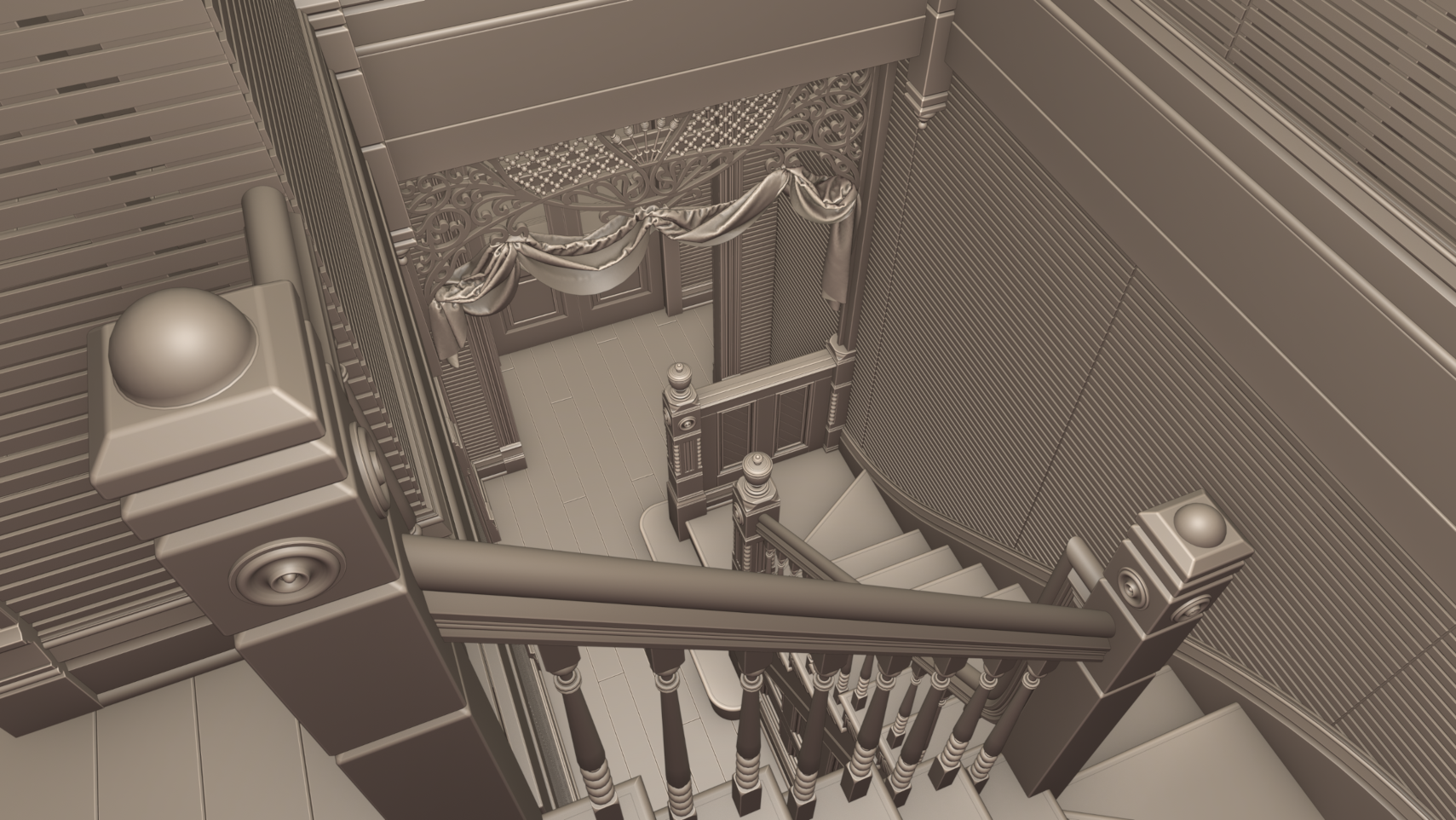
Obviously I haven’t plastered and papered the wall yet. 😀 Just bare wall lath, door/window casing, and floor/crown moulding.
For the grille structure, I referenced several catalogs from the time period and then drew up the design with curves in Inkscape. Using grease pencil or trying to work with curves in Blender didn’t really get me the result I wanted, and it was much easier to just draw the design in Inkscape, and then import the SVG into blender > convert to curve > adjust as needed > convert to mesh. I did a lot of cleanup and then did a rough retopo of it, and then broke it into separate parts (as in RL, it would have been sawn from a pattern but cut into parts for assembly/shipping). It’s essentially about 5 or so planes, with a 1 inch solidify modifer. Very slight bevels, which aren’t really noticeable, but if viewed close up, you can see the seams where the parts would have been assembled. Maybe a completely pointless detail, but it might come in handy when baking maps in substance painter.
The details are simple.. just wooden dowels with balls and ornaments attached. Moulding catalogs from this era are filled with measurements and designs for these.
For the draped cloth… It’s supposed to be a silk chiffon material threaded through hoops on the grille. I decided to use Marvelous Designer rather than Blender cloth simulation, as it had to be pulled and draped. MD isn’t really meant for large cloth simulation, but it can do it. It’s so easy to use to make clothes, but trying to get it to do stuff other than that is a challenge. So, I had to use some creative methods. I may redo this in the future, as I later figured out a way to pull/loop the cloth through the grille with a simpler method. I’d have to start over on making the cloth, and I kind of burned myself out on it though, and wanted to get back to Blender! 😀
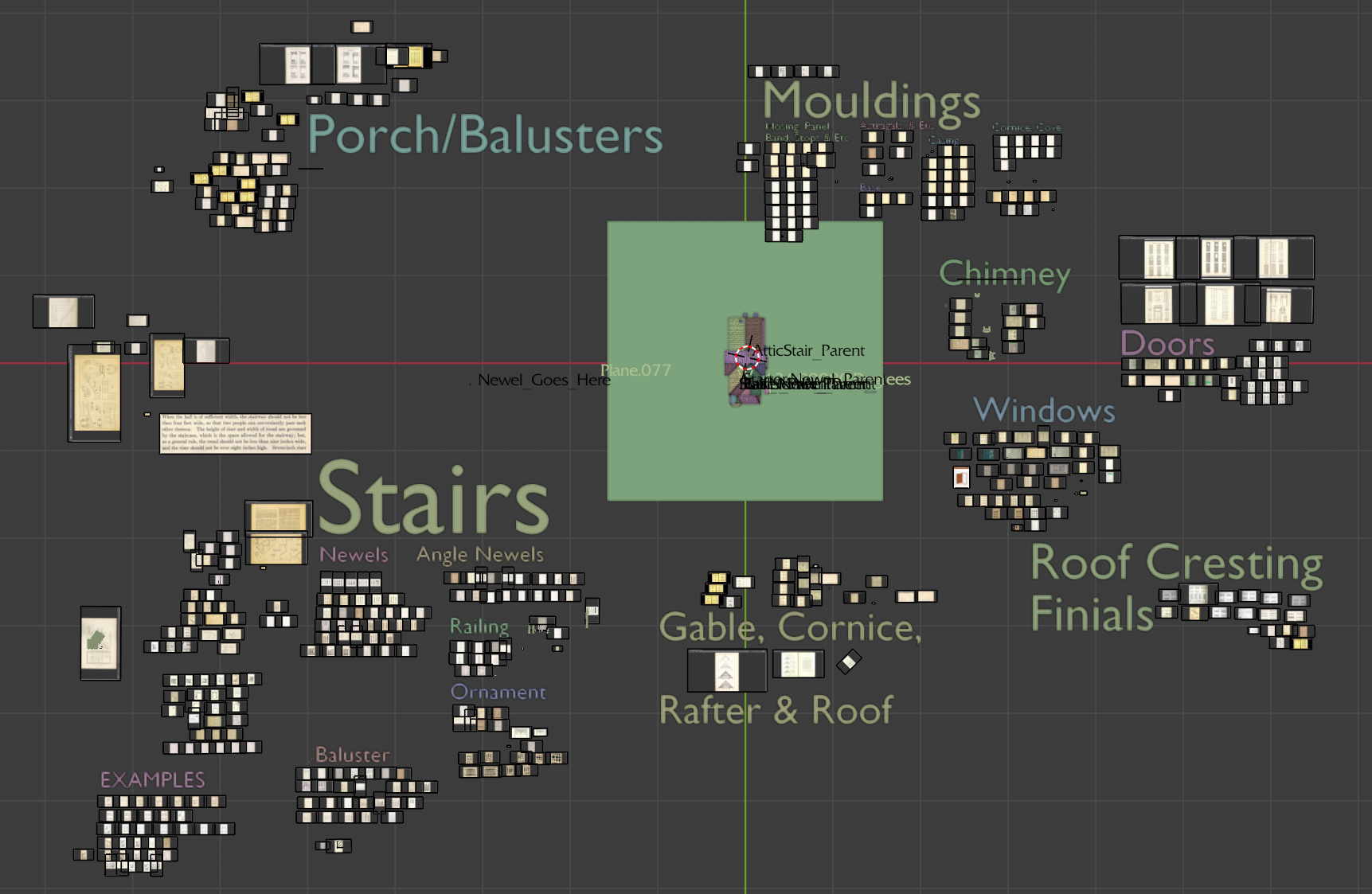
My Pureref file is growing:

But sometimes you need more…