I am struggling slightly with how to conceptualise this. If I create a completely diffuse cube and put it next to a co…

Forum Archive I am struggling slightly with how to conceptualise this. If I create a completely diffuse cube and put it next to a co…

Viewing 5 posts - 1 through 5 (of 5 total)
  • Author
    Posts
  • #4213
    status451_cg
    Participant

      I am struggling slightly with how to conceptualise this.

      If I create a completely diffuse cube and put it next to a completely glossy sphere, with zero diffuse bounces why can I still see the cube reflected in the sphere?

      Does the light not have to come from the lamp/world, bounce off the cube and hit the sphere? But with zero diffuse bounces it doesn’t.

      #22152
      Jasmine Wongus
      Participant

        I know it’s 4 months later, but I think if you have any glossy bounces, that’s what deals with reflection between the surfaces, or at least the specular reflections of light…I think. I just started, I’ll try that out just to know, myself.

        #22153
        status451_cg
        Participant

          Hey

          Thanks for the reply. 4 months or not, I’m still only on the cusp of grasping it!

          I think the important thing I didn’t recognise is that Cycles is a *backwards* path tracer. This Stack Exchange question is really helpful in understanding how Cycles works: http://blender.stackexchange.com/questions/5820/how-is-cycles-different-from-blender-internal

          Once you appreciate that, it’s a little easier to visualise why this happens… though I am still getting it straight in my head.

          #22154
          Jasmine Wongus
          Participant

            I love checking out Stack Exchange… Maybe I’ll also figure out more with these Cycles…I just…I dunno, glad you figured some things out, though! That’s definitely where I’d like to be, too!

            #22155
            Alexander Tokarev
            Participant

              @lewis2e:

              I guess, what looks like a reflection of the cube in your sphere is actually a black cube-shaped hole against the reflection of the direct light sources (such as Lamps/World Surface Colour/HDR/Emission Object) that are present in your scene. In other words, it’s not a reflection of the cube that you’re seeing in the sphere, it’s “the reflection of the direct light minus the cube”.

              As far as I understand, one Glossy bounce = one reflection (in a glossy surface) of the light, reflected from other surfaces (i. e. from other visible geometry,  not directly from light sources). That’s why you can still see the reflection of the direct light in the glossy sphere when you set Glossy to zero, but at the same time see a “black hole” instead of the cube.

              See picture below. It’s an Emission cube (blue), a Diffuse BSDF cube (red) being reflected in a Glossy BSDF sphere. All three are sitting on a white plane and are lit by a green World Surface and a yellow Point Lamp. The Glossy and Diffuse bounces are set to zero.
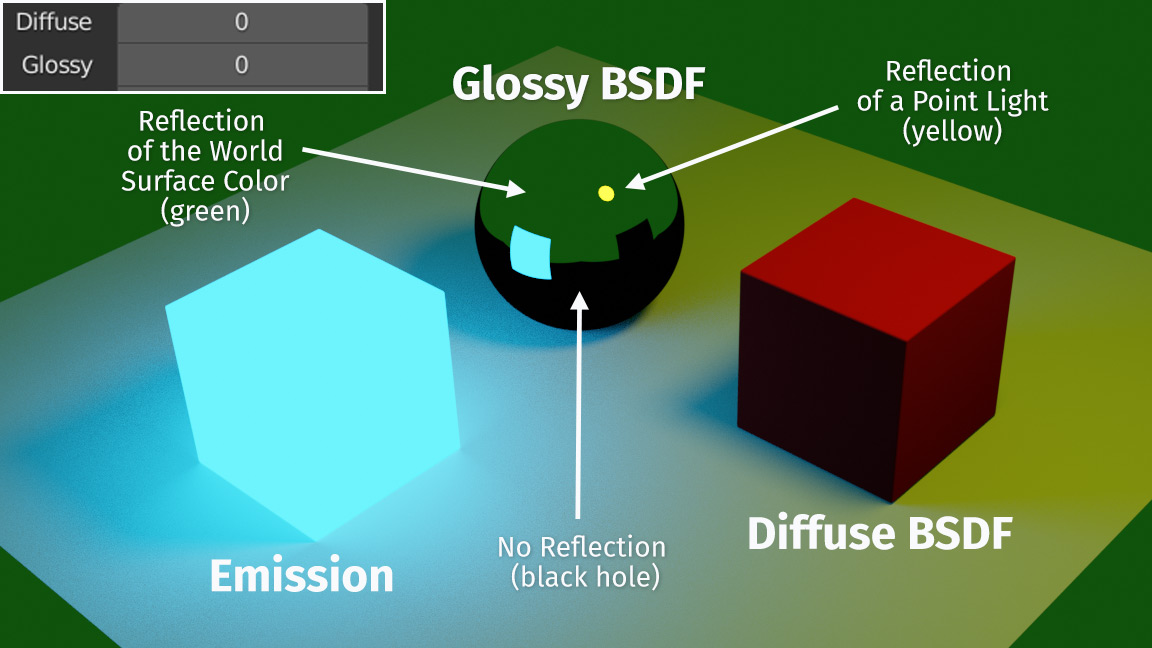
               You can see that despite Glossy=0,  the Emission cube, the Point light and the World Surface Color are still being reflected in the glossy sphere – because they are sources of direct light. However, the bright blue halo of the Emission cube does not reflect in the sphere, because the halo is not a direct source of light. The Diffuse cube and the plane also do not reflect in the sphere; a black hole is reflected instead of them.

            Viewing 5 posts - 1 through 5 (of 5 total)
            • The topic ‘I am struggling slightly with how to conceptualise this. If I create a completely diffuse cube and put it next to a co…’ is closed to new replies.